Registered NDIS Provider

Disability support, on the participant's terms.

A Plus Nursing is a registered NDIS provider delivering disability support and nursing services to participants in their homes and communities — built around choice, control, cultural respect and continuity of care.

Support worker and an NDIS participant chatting at an outdoor community garden café
Our approach

Person-centred, in the way the NDIS actually means it.

Support that reflects the participant's goals, preferences, culture and routine — not a roster's convenience.

Choice & control

Participants choose their workers, schedule and goals — and can change them.

Continuity of care

Consistent workers wherever practical, so participants build trust, not adjust constantly.

Cultural respect

Workers matched on language, gender and cultural preference where available.

Safety & dignity

Documentation, supervision and clinical oversight that protect participants without infantilising them.

Supports we deliver

Everyday supports, all the way through to high intensity.

Refer a participant →

Daily personal activities

Showering, dressing, grooming, toileting, mobility, mealtime support — at home or in the community.

Community access & participation

Skill-building outings, group activities, social and recreational participation, supported volunteering.

Transport & appointments

Travel support to medical, allied health and community appointments, and accompanying participants while there.

Household tasks

Cleaning, laundry, meal preparation, groceries and the practical work that keeps a household running.

Behaviour support implementation

Workers trained to deliver positive behaviour support plans developed by qualified BSPs.

Skill & independence development

Goal-focused support that builds the participant's capability, not just helps them through the day.

Clinical assessments

Nursing assessments that drive better plans.

Registered nurses conduct in-home and in-facility assessments — practical findings, clear recommendations, and evidence support coordinators and plan managers can use at review.

Request an assessment →

Continence assessments

Bladder & bowel assessment, continence aid prescription, toileting and bowel care plans, review of existing routines.

Manual handling assessments

Transfer, hoisting and mobility assessment with equipment and technique recommendations — for participants, workers and households.

Home & falls risk assessment

Walk-through of the home environment, identification of falls and safety risks, and pragmatic modification recommendations.

Wound & skin integrity

Wound assessment, pressure-injury risk staging and dressing-plan recommendations, reviewed at scheduled intervals.

Medication management

Review of current regimen, Webster pack set-up coordination, administration competencies for support workers and refill planning.

Mealtime management

Dysphagia-aware mealtime planning, texture and fluid recommendations, mealtime support routines for workers.

Assessments are conducted by registered nurses within scope of practice. Specialist clinical referrals (speech pathology, OT, dietetics) are coordinated where appropriate.

High intensity supports

Complex care, with nursing oversight.

For participants with complex and high intensity support needs, our trained support workers operate under nursing oversight, with clear care documentation and risk planning behind every shift.

  • Complex bowel care support
  • Enteral / PEG feeding support
  • Urinary catheter support
  • Subcutaneous injection support
  • Diabetes management support
  • Mealtime management support

Supports delivered are dependent on participant assessment, current plan funding, clinical requirements and appropriate documentation.

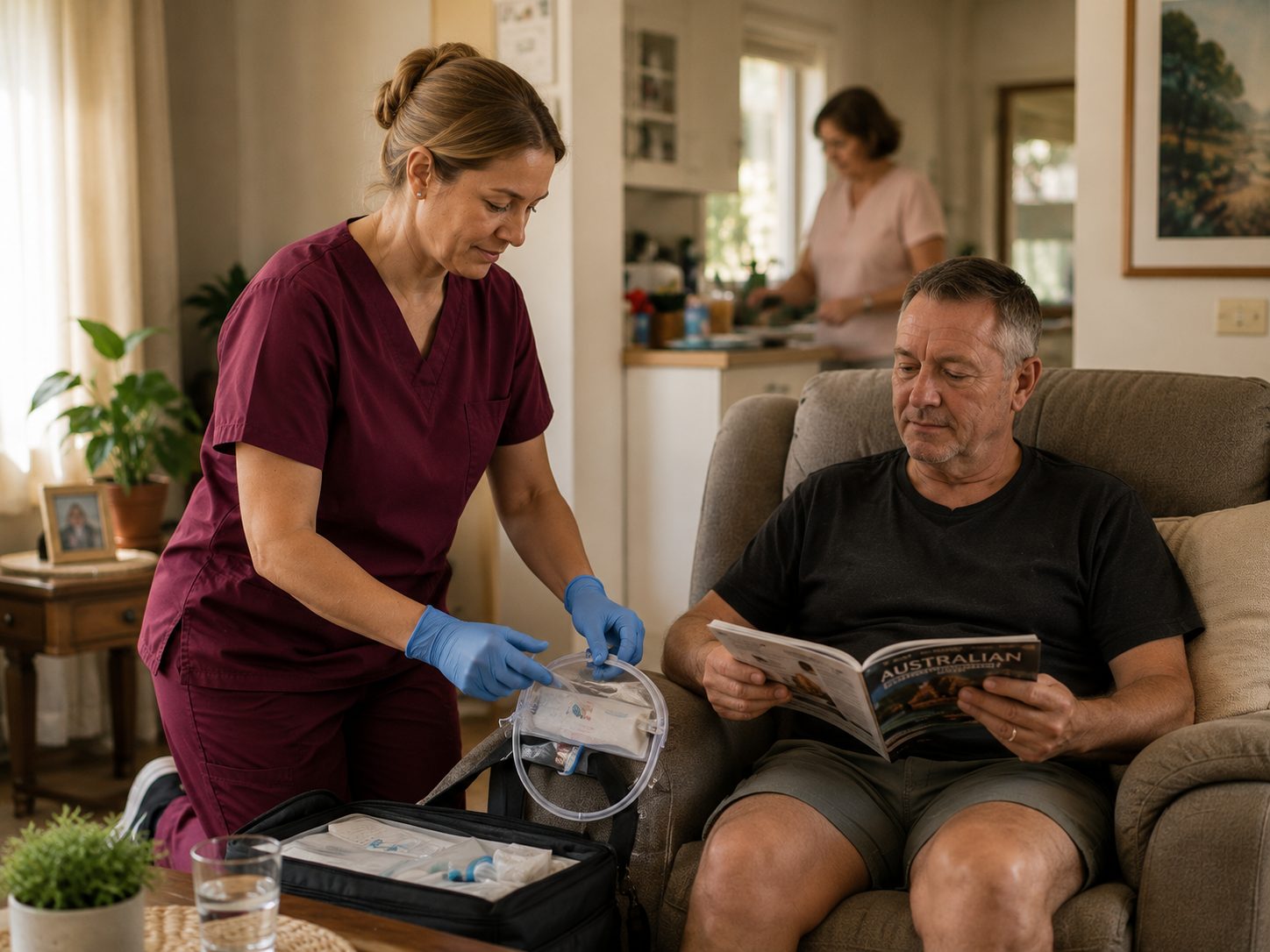
Registered nurse setting up enteral feeding equipment in a participant’s home
Accommodation supports

Supported living — and the bridge before it.

For participants whose plan funds shared or transitional accommodation, we provide the rostered support, overnight cover and clinical oversight that make the home actually work.

SIL · Supported Independent Living

Shared homes, with the staffing to back them.

Rostered supports for participants living together in shared accommodation — including 24/7 active and sleepover models. We work with SDA providers, plan managers and support coordinators to build a roster that fits the household, not the other way around.

  • Active and sleepover overnight shifts
  • Individualised daily supports per resident
  • Behaviour support plan implementation
  • Nursing oversight for high intensity needs
  • Compatibility-aware worker matching
MTA · Medium Term Accommodation

A safe stop, while the long-term home is sorted.

Up to 90 days of supported accommodation while a participant waits for confirmed long-term housing — hospital discharge, home modifications, or a change in living circumstances. We coordinate with discharge planners and support coordinators to stand the supports up quickly.

  • Rapid set-up — usually within five business days
  • Coordinated with hospital discharge planning
  • Daily supports, clinical care and overnight cover
  • Hand-off plan to long-term SIL or in-home supports

SIL and MTA supports are delivered where the participant's plan funds these line items. Talk to our intake team about your participant's specific arrangement.

Referral flow

From referral to first shift — usually within the week.

We respond to participant referrals on the same business day.

01

Submit a short referral

Eight fields. Your details, the participant's funding, the supports being requested.

02

Same-day intake call

Our intake team calls to confirm scope, clinical needs, behaviour support and preferred worker profile.

03

Service agreement & plan

A clear service agreement, the supports being delivered, and the schedule. Plan documents collected.

04

First shift & review

Worker introduced. Participant feedback gathered after the first two weeks; adjustments made.

FAQ

What participants and coordinators ask.

Are you a registered NDIS provider? +
Yes. A Plus Nursing is a registered NDIS provider and can deliver supports to self-managed, plan-managed and NDIA-managed participants.
How do you match workers to participants? +
By the supports being requested, the participant's location and routine, the participant's preferences (gender, language, cultural background where available) and the worker's qualifications and screening status.
Can we request the same worker each shift? +
Yes — continuity is the default goal. We schedule consistent workers wherever rostering permits, and treat changes as something to be explained, not assumed.
Do you provide SIL or Medium Term Accommodation (MTA)? +
Yes. We deliver rostered supports into Supported Independent Living (SIL) houses and into Medium Term Accommodation (MTA) placements — including overnight active and sleepover shifts, daily supports per resident, and clinical oversight where needed. We work with SDA providers, discharge planners and support coordinators to stand new arrangements up quickly. Eligibility depends on the participant's plan funding for those specific line items.
Can a registered nurse conduct a continence or other clinical assessment? +
Yes. Our registered nurses conduct continence assessments, manual handling assessments, home and falls risk reviews, wound and skin integrity assessments, medication management reviews and mealtime management assessments. You'll receive a written report with practical findings and recommendations that can support plan reviews.
Do you deliver high intensity supports? +
Yes, with appropriate nursing oversight, documentation and worker training matched to the participant's support needs. Specific supports are confirmed during intake.
How do you handle feedback and complaints? +
Feedback is encouraged at any point — by phone, email or in person. Formal complaints are logged, acknowledged within one business day, and progressed transparently. Participants can also escalate to the NDIS Quality & Safeguards Commission at any stage.

Refer with confidence

Got a participant who needs support?

Eight fields. Same-day response from our intake team. No formal report required at the referral stage — we'll collect what we need on the intake call.